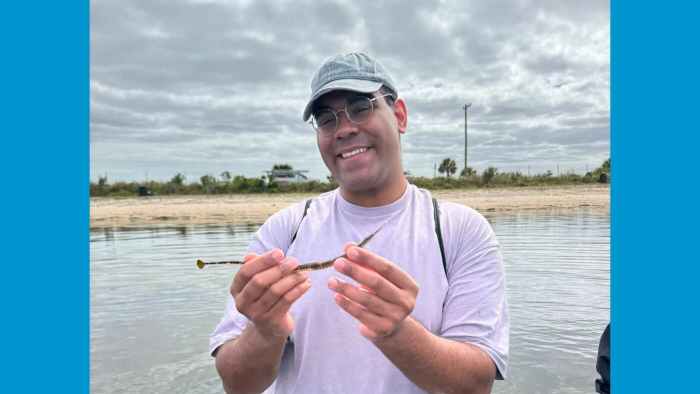
Cover image portrays Nick Davis holding a Chain Pipefish. Taken by Dr. Sarah Krejci.
2022-23 ARUSA Conservation Intern Nick Davis shares about his recent research and the importance of science communication. Blog post by Liuan Huska.
Whether the water is 50 degrees or 80 degrees, whether the wind is whipping or the water is calm, Nick Davis can often be found out in the Indian River Lagoon in Florida, doing fieldwork for the Aquatic Research Lab at Bethune-Cookman University. On a gorgeous April day last year, Nick’s first push of the net turned up some Gulf Pipefish, including a few pregnant males, a couple Chain Pipefish (including a juvenile), a Pufferfish, a tiny Hogchoker, and even a fossilized shark tooth.
Looking around the still waters of the lagoon that day, Nick took in the fact that here he was doing marine biology for a living. This was something he had always dreamed of, growing up in landlocked Indiana. But before his conservation internship with A Rocha USA, he couldn’t see a clear path forward to get there.
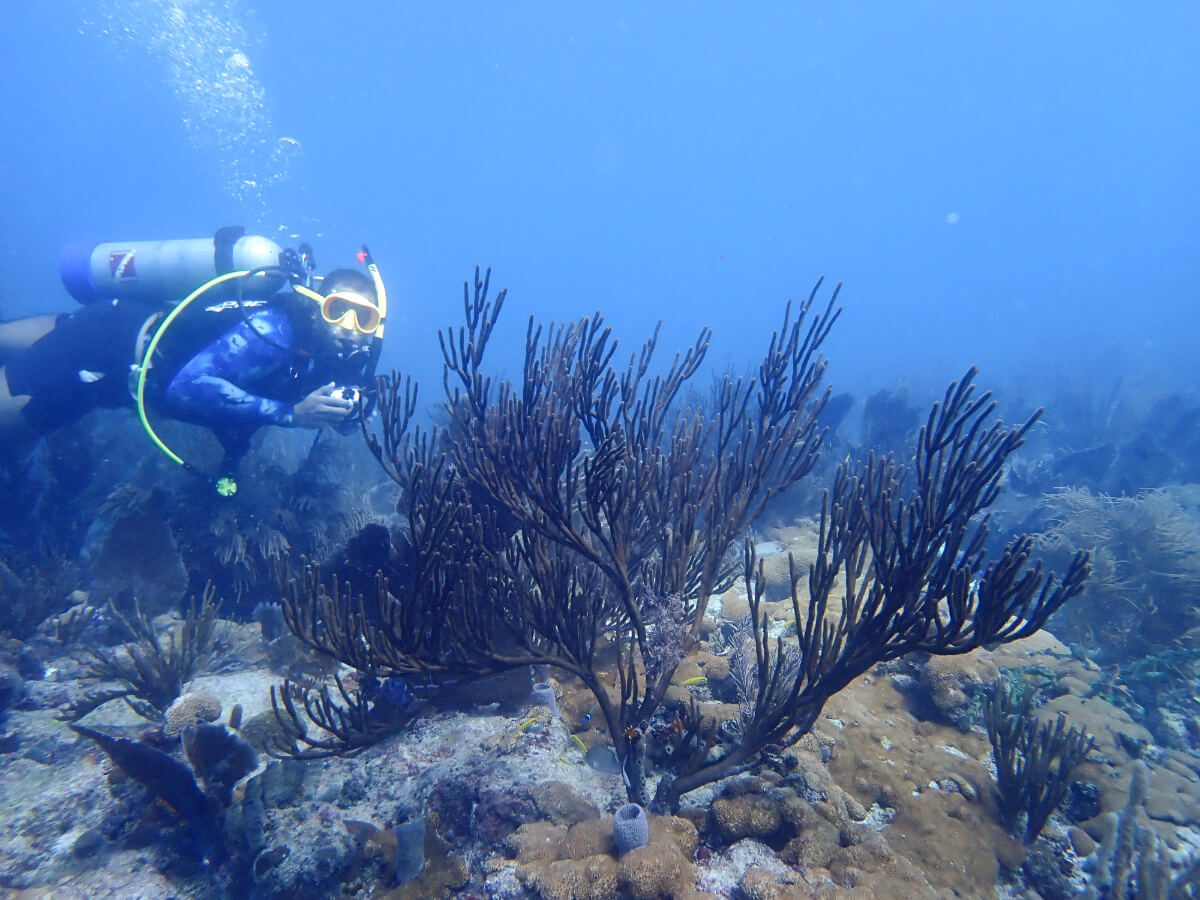
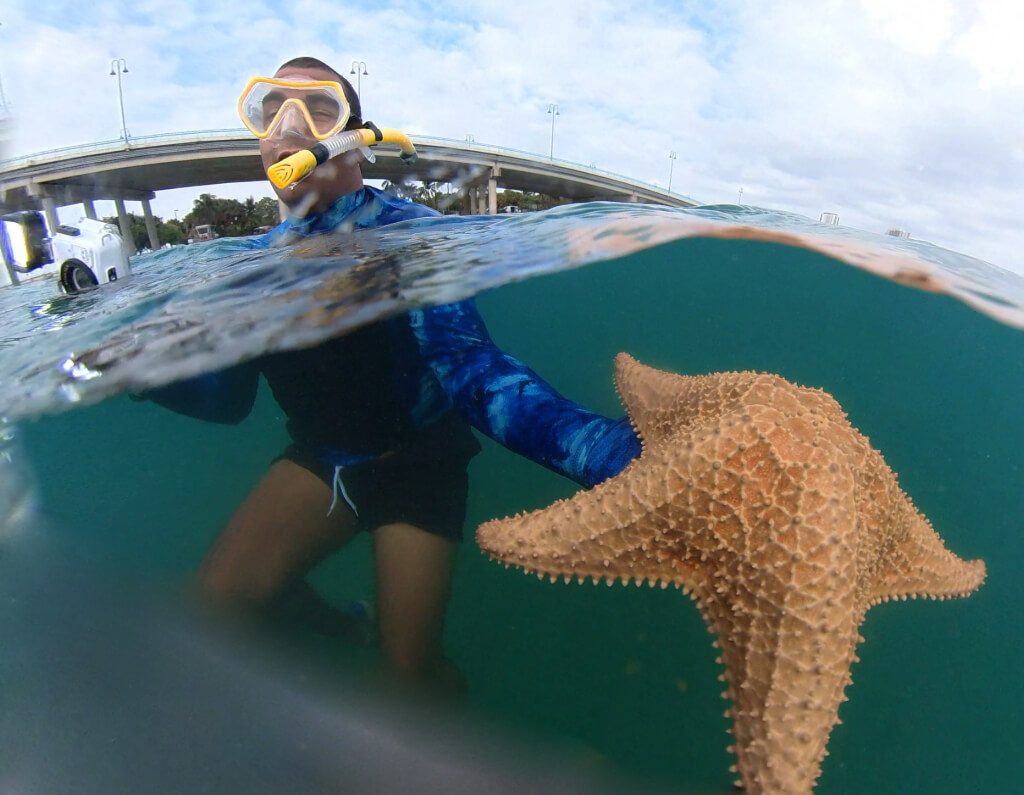
(L) Nick Davis with Black Sea Rod. (R) Nick with a starfish.
Stepping Stones
“Seaworld Trainer” is what first grader Nick would tell people who asked what he wanted to be when he grew up. By the time he was an undergraduate at Goshen College in Indiana, that pull toward the ocean focused into a marine biology major. Nick’s freshman class “Ecology and Evolution” began to bring together what had previously been separate – science and his Christian faith. Evolution can be part of creation, he realized, and you can be a scientist and a Christian simultaneously.
After college, Nick knew he wanted to get a master’s degree, but needed more experience first. “The A Rocha internship was an amazing guiding light and stepping stone,” Nick said. Between 2022 and 2023, Nick spent nine months with Director of Marine Conservation Bob Sluka and two other interns in Titusville, Florida. He developed a deeper understanding of the creatures and challenges of the Indian River Lagoon, became SCUBA certified, honed his underwater photography skills, and networked with other researchers around the lagoon, including Dr. Sarah Krejci, who invited him to apply for the marine biology master’s program at Bethune-Cookman University in nearby Daytona Beach.
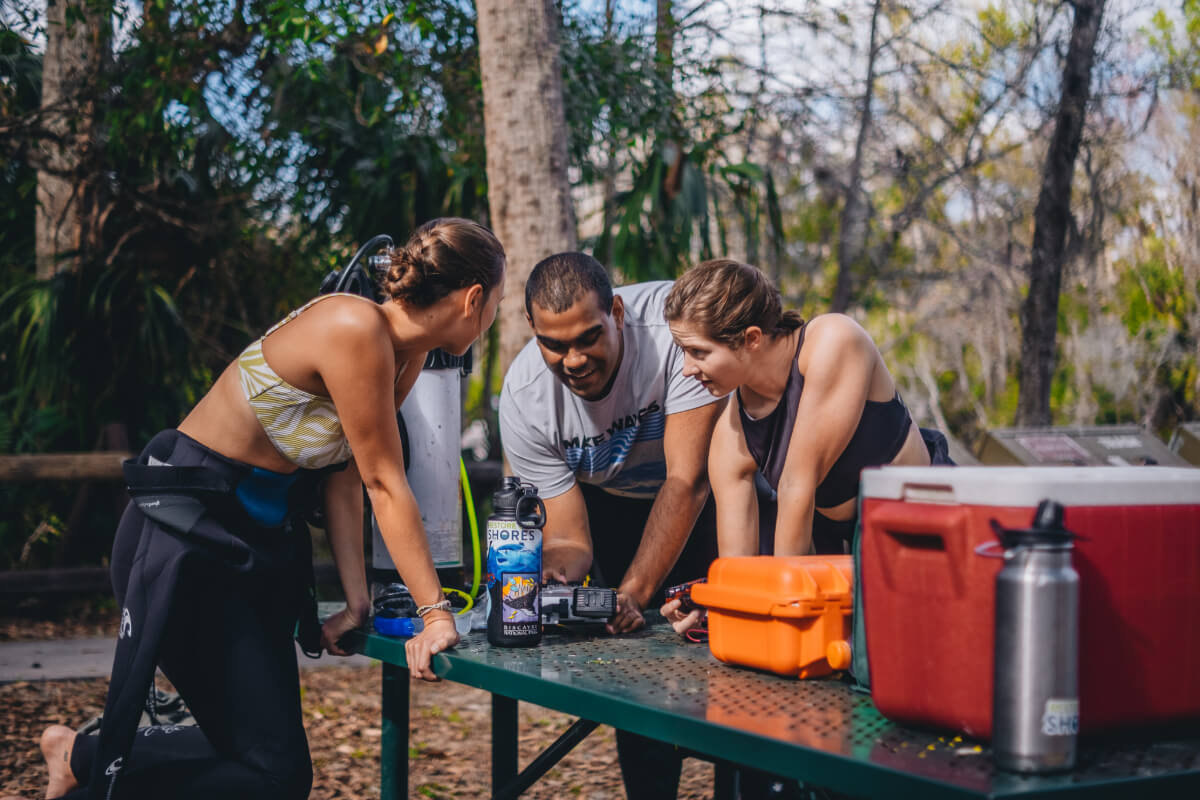
(L-R) 2022-23 Conservation Interns Michaela Stenerson, Nick Davis, and Alli Cutting.
Nick completed his master’s thesis in December 2025, comparing the feeding habits of the Gulf Pipefish (Syngnathus scovelli) and Chain Pipefish (Syngnathus louisianae). The two species are similar, but have different anatomy and range. Although the Gulf Pipefish is a species of “Least Concern” on the IUCN (International Union for the Conservation of Nature) Red List, the Chain Pipefish is listed as “Data Deficient.” That means there is not enough known about the Chain Pipefish to determine whether they are endangered or not. One-third of Syngnathiformes species (out of 97 total) are classified as Data Deficient on the IUCN list. “A lot of species could be at risk of extinction, because there aren’t regulations in place, and we don’t have information,” Nick observed.
Nick described the aims of his master’s research in an Instagram video sharing some fieldwork footage: “These fascinating fish… inhabit the Indian River Lagoon and depend on the same prey. However, ongoing environmental issues like harmful algal blooms that result in seagrass decline threaten their habitat and food sources, potentially increasing competition between them.”
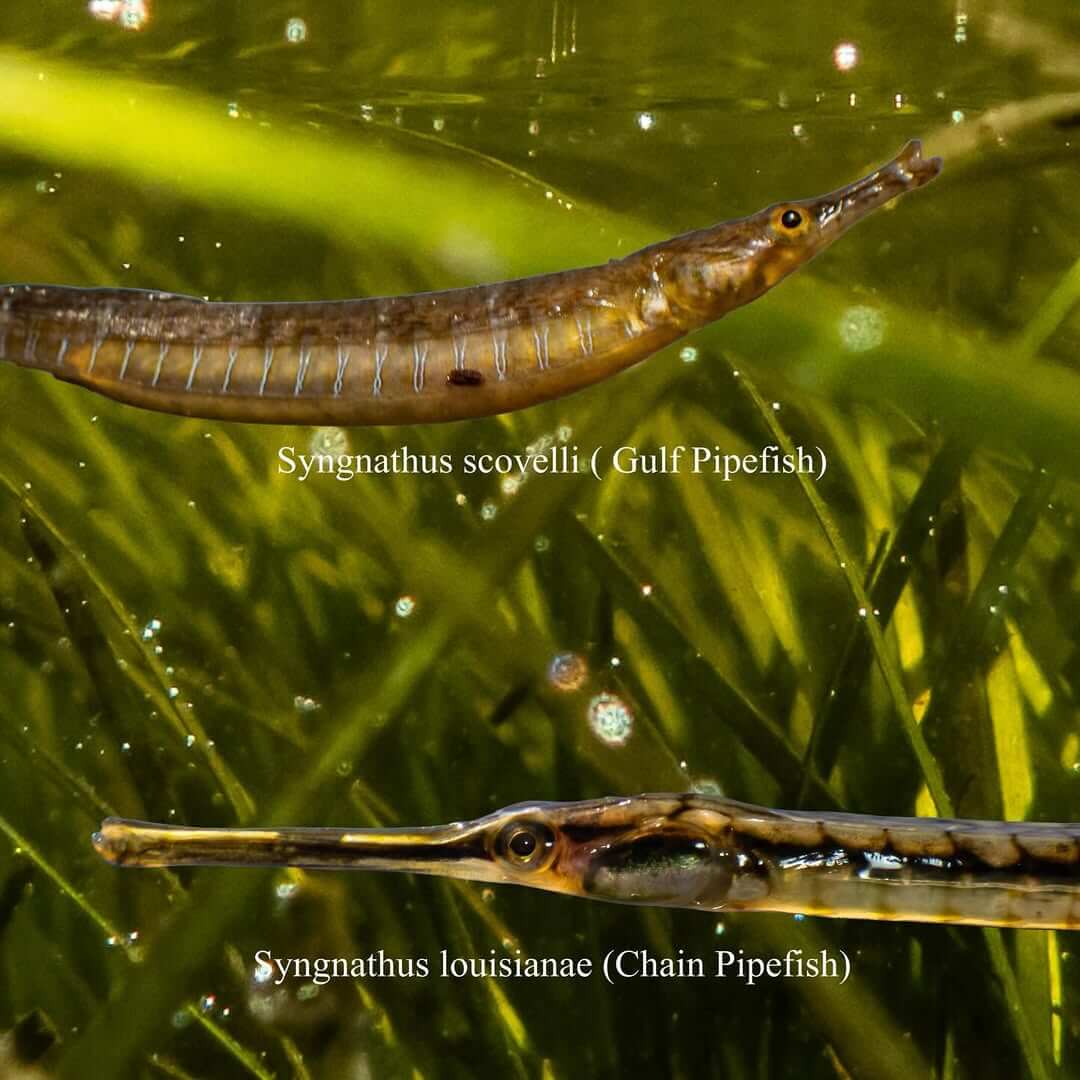
Image by Nick Davis.
On his Instagram post, he went on to explain, “In this study, we’re conducting gut content analyses on specimens from shared habitats to assess diet overlap. Additionally, we’ll use high-speed videography to examine their feeding kinematics, and determine if one species may hold a competitive advantage in terms of capturing a commonly shared prey item.”
Science in Service of Love
That Instagram video is one example of Nick’s aptitude for science communication. Starting in the early days of the pandemic, Nick began sharing videos of a Porcupine Fish named Dumpling who lived in Goshen College’s zoology lab. As these close-ups got more and more views, Nick included more creatures and transitioned to more educational content.
“Science communication is one of the most important aspects of research,” Nick said. “We need to get it out there to the general public.” Using social media, he continued, allows scientists to raise awareness about species that many are not familiar with and learn about issues like habitat loss and pollution that might be affecting people’s local ecosystems.
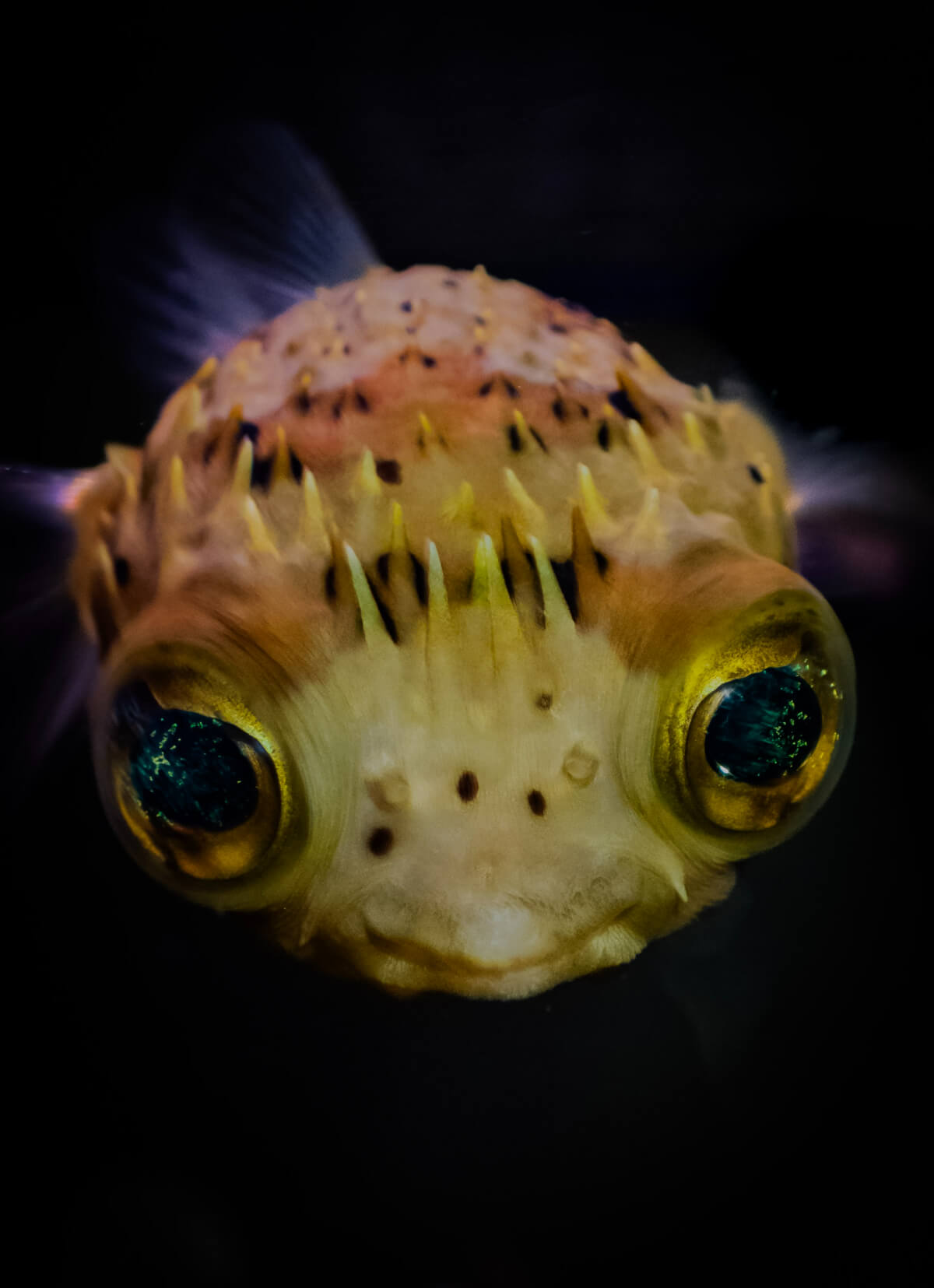
A Porcupine Fish from Nick’s social media account.
Nick ultimately found that Gulf Pipefish inhabit a wider area throughout the lagoon, whereas Chain Pipefish are more limited. Gulf Pipefish also consume a broader variety of prey – his study tallied more Chain Pipefish with empty guts, because this species is less versatile in what it consumes. Chain Pipefish, therefore, are more vulnerable to habitat disruptions that change the distribution and availability of its prey.
For Dr. Bob Sluka, Nick’s mentor during the A Rocha internship, Nick’s research is an example of creation care in action. “We now know something about this species that wasn’t known before,” Sluka stated. More data on the Chain Pipefish and Gulf Pipefish then informs A Rocha’s collaboration with other conservation partners in the area, like the Brevard Zoo, in doing seagrass restoration. The Chain Pipefish is especially reliant on seagrass for habitat. “It really provides the basis for implementing our Christian values,” Sluka continued. “How do we love that pipefish species? Nick is providing a way for understanding it and taking action.”
Glimpses of Restoration
Now that he’s completed his master’s degree, Nick will continue as a lab manager and research assistant at Bethune-Cookman. He’ll keep mentoring undergraduate students and facilitating research. Though taking on expanded leadership roles sometimes feels out of his comfort zone, he’s excited to grow his skill set and see undergraduates gain confidence in doing research. Nick also plans to pursue a PhD.
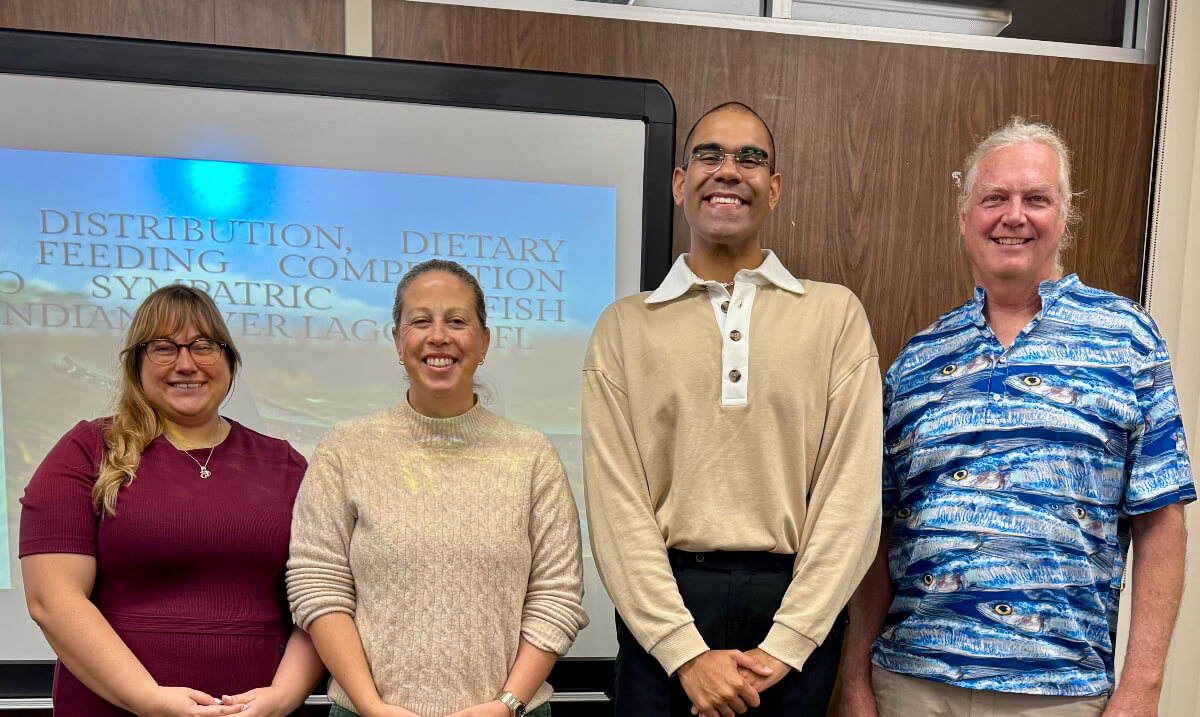
Nick and his thesis committee: (L-R) Dr. Sarah Krejci, Dr. Roisin Stanbrook, Nick, and Dr. Bob Sluka.
As a Black scientist growing up in a place with few access points to training in his field, Nick has overcome doubts from his family that this path would be viable as well as his own anxieties. He encourages others, “If you’re really passionate about something, stick to it. Even if you have that sense of impostor syndrome, as hard as it might be, try to get out of your comfort zone and work through it.”
Though Nick has stepped back recently from being as active on social media, his account continues to draw fascination and questions from followers. “Even the smallest species,” Nick said, “can incline people to care about some of these broader issues.”
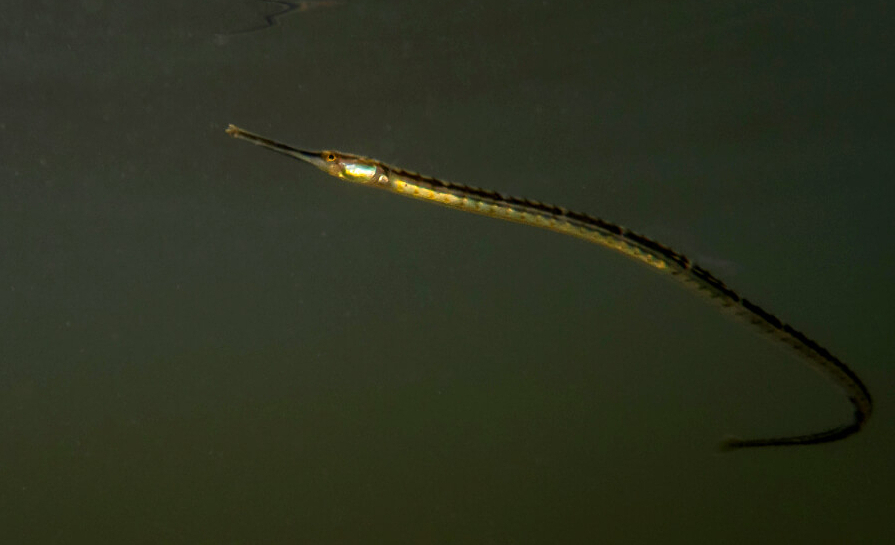
Chain Pipefish (Syngnathus louisianae) in the Indian River Lagoon, by Nick Davis.
When faced with the enormity of the issues confronting the Indian River Lagoon and its many creatures, Nick thinks of moments of pure joy out in the field, like the summer afternoon in 2024 when his team saw juvenile seahorses again after many months of observing mostly Gulf Pipefish. Or he thinks of one of their study sites along the Canaveral National Seashore, where efforts at seagrass restoration are aiding the return of dense seagrass beds that used to blanket the entire lagoon. “It gives a bit of a preview of what the rest of the lagoon could look like in the future,” he said, “if we continue with these efforts.”
Nick also recalls a moment from his time as a marine educator in Pigeon Key, Florida. After teaching a group of kids about the causes of seagrass loss, they went out to a reef. The children noticed right away that a boat had gotten too close to the island and gouged a propeller scar into the seagrass. They also noticed that someone had used an anchor, another cause of seagrass loss. “The kids recognized that and let somebody know. They were just really catching on.”
Nick treasures these moments of education and action. “Kids are so open to learning, and recognizing how we affect our planet in these ecosystems,” he reflected. “It gives me hope for the future.”
Donate to support our Conservation Internship Program.
Read more about Nick Davis’s Chain Pipefish research on his Creature Feature blog post!
Add a Comment