
By Jeffrey Greenberg
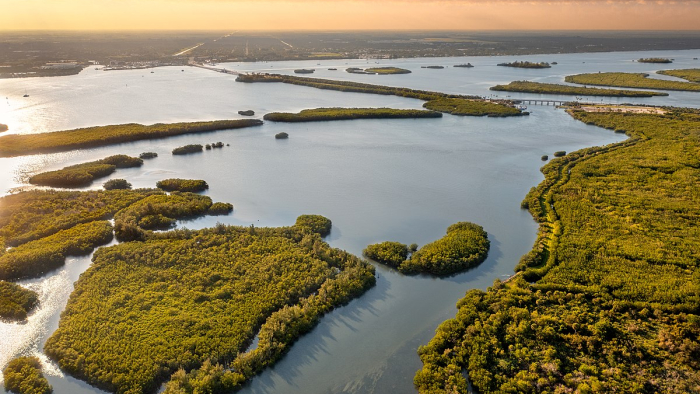
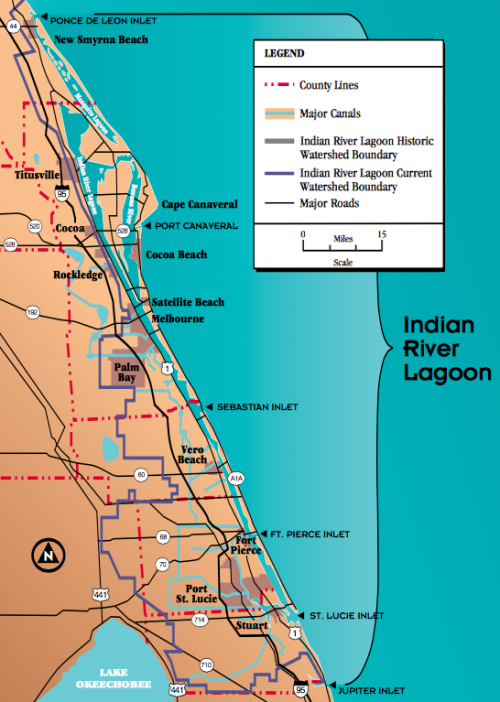
Dr. Jeffrey Greenberg leads SWIRL, an A Rocha USA stormwater investigation designed to protect the Indian River Lagoon (IRL), the longest (150-plus mile) stretch of estuary in the United States and a biodiversity hotspot. Below he describes the problem of freshwater runoff into the IRL and how stormwater monitoring efforts can lead to evidence-based solutions.
My investigation into stormwater issues began upon buying a new residence in Titusville, Florida in 2020.
After losing my dear wife, Diane, in 2020 and deciding to return to a part of Florida like where I grew up in the 50s and 60s, I went house-hunting in Titusville (just landward of the Kennedy Space Center). This area had attracted me but got a great boost from Dr. Bob Sluka, whose family lives only a few minutes away from my house now. Bob’s passion for all life and especially marine critters is well fit with his role in A Rocha USA. I am now a regular volunteer with A Rocha and hoping to contribute from my background as an earth-environmental scientist and educator.
Drainage ditches and water cycles
It surprised me that the quarter-mile long stormwater drainage ditch that borders my backyard, instead of being a mosquito haven, is almost skeeter free, due to wonderful mosquito fish, dragon flies, and swallows! I was also delighted to observe six kinds of turtles (sliders, chicken turtles, mud turtles, snappers, soft shells, and cooters), loads of fish species, every wading bird known in Florida (except the newly-established flamingos), two species of water snakes, frogs, gators, and even a visiting otter. My initial desire was to seek out teachers and students to do a bio-assay of the creek’s life. I made trash clean-out a priority for myself.
In the larger context, there are thousands of these ditches all along the coast here that divert stormwater from natural flow and into the IRL. This is one of the country’s sad legacies, to drain nature so that farmers and developers can misuse the land. Florida is unique as a geological region with groundwater and surface water flow, beginning in southern Georgia and moving through fractured limestone, sand/sandstone, and wetland streams south, ultimately arriving in the Gulf of Mexico (through the amazing Everglades). The precious water cycle here has been subverted by politics and financial greed, such that both coasts are contaminated and the Glades degraded. Some efforts have been made over 30+ years to restore paradise. Too often, though, good science and care for creation has lost out to corruption of those who have the authority to heal the situation.
Why monitor stormwater?
A pitiful poster child for the degradation of the IRL over 40 years is a bloated-dead manatee. Nearly one third of their population along our coast has starved to death. Why? The simplest villain to name is algal blooms from the influx of fertilizers and sewage. While likely major factors, the true picture is more complicated. The 1800 or more stormwater outfalls in Brevard County alone redirect billions of gallons of freshwater and all the contaminants we produce into the estuary-lagoon. This terrestrial water should be staying to the west receiving natural treatment, and moving via the extensive natural Saint John’s River system southward.
The bottom line on the SWIRL concept is stewardship. Good hearted people devoting time and effort and some finance to serve the restoration of God’s fragile ecology. What we want to quantify and estimate is how much fresh water is ruining the IRL’s natural salinity and where pesticide, herbicide, petroleum distillates, pharmaceutical, PFAS (deadly forever chemicals), silt, partially-decayed vegetation, and trash is being sent into the once productive coastal region. In one isolated case, Brevard County has built a worthy system to send all the misplaced water back west. This type of project is great but way too expensive, and not necessary for the great majority of outfall drainages. I honestly believe we have solutions to the disease affecting this major ecosystem.
Starting the SWIRL project
Back in 2022, I partnered with a former Wheaton College environmental geohydrologist to apply for a National Science Foundation grant. The funding would have supported citizen science efforts to study and monitor stormwater. Desired practitioners included local students and instructors, and many excellent volunteer experts. Our proposal was rejected, and that was not a big surprise, except that our vision was indeed far more bang-for-the-buck than the local project that was awarded.
Instead of quitting the plans for stormwater monitoring, I gathered a great team around the new SWIRL initiative and set out with a very small grant (thanks to the Haddock Family Foundation of Orlando) to accomplish a pilot program here in Titusville. I should mention that I had naively, apparently, sought to get our City Council on board with what would benefit all of us, except the developers. My request for cooperation was rather rudely opposed. I won’t add detail, but note that ironically, Titusville has a deserved reputation for environmental abuse.
Challenges and possibilities
The new SWIRL is “staffed” by some accomplished tech experts, including faculty at Eastern Florida State College (EFSC), a top high-school science mentor, and us A Rocha folk. The initiative is comprised of two parts:
A) The development, testing, installation, and data collection from a small, inexpensive package of remote water-quality/quantity sensors. A prototype would be installed at our pilot site. Thus far, the disadvantages of volunteer labor force and limited funding has delayed the prototype. Hope is still there for a breakthrough.
B) The operation of excellent analytical instrumentation at local EFSC, was planned to determine the presence of harmful pollutants in the outfall waters, again, initially at the pilot site. I also applied and received a small grant from Florida’s agents of the National Estuary Project. We have a nice portable water-quality probe and tests for the presence of coliform bacteria. Unfortunately, our efforts to utilize a fine gas-chromatograph mass-spectrometer at EFSC has been dropped, at least currently, because the state fired our chemistry professor. This is after we put over $7,000 into the updating of the unit. But, EFSC biology professor Dr. Jim Yount has stepped up and rejuvenated a good HPLC (high-precision liquid chromatograph). He has even now proven that bad herbicidal compounds are entering the IRL from our pilot outfall site. We expect to push this capability further and add it to my weekly data from portable monitoring.
So far, I have to report that of the many environmental groups trying to “save the lagoon,” almost none are on the right track. Yet all are seeking continued funding for things that have not shown good effect over a decade or more. Many hundreds of thousands of dollars have been awarded to groups and spent in monitoring the IRL, within the estuary but not testing its input contaminants. SWIRL offers the missing, essential service and at much lower expense. I hate thinking that money is the key. Prayers are our hope, along with the will of good souls (including students) who are called to serve. I hope for people of faith to see the area’s degradation of their corner of Creation and be called to serve its restoration.
All of SWIRL’s data will be saved via a local and then major, regional database. Anyone desiring to study and join the noble effort for lagoon restoration is welcome to use our analytical results. If the SWIRL vision continues and rightfully grows to include multitudes of other outfall sites, we can then specify the harmful stormwater contents and where they originate. Science informs but can not demand action. However, our hope is for the initiative to create demand from the public for change. It is encouraging to imagine an Indian River Lagoon as it was only forty or so years ago, clear as glass even at ten foot depths, with plentiful seagrass, healthy populations of manatees, bottlenose dolphins, gamefish, clams, oysters, starfish and seahorses!
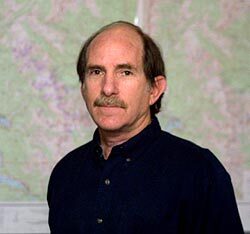
Dr. Jeffrey K. Greenberg is a professor emeritus at Wheaton College in Illinois, where he served for 20 years as Chair of the Earth and Environmental Science department.
He now volunteers as Associate Scientist for A Rocha USA at our Florida conservation project.
Add a Comment