
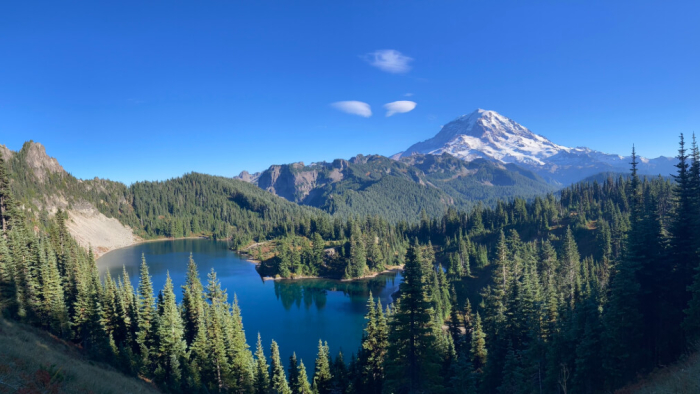
Cover image is of Mount Rainier, by ARUSA Director of Conservation Brittany Michalski.
by Noah Guthrie
A Rocha USA worked with Good Faith to develop the Christians and Climate Change podcast series! These four episodes feature interviews with Christian leaders and activists who care for God’s creation by mitigating climate change. They discuss the biblical basis for this work, its ramifications for our human and more-than-human neighbors, and ways to pursue it with wisdom and perseverance.
You can access all four episodes using the following links.
Katharine Hayhoe: Talking About Christian Climate Action Is a Gospel Issue
Dr. Jonathan Moo: Loving God, Neighbor, and the Natural World
Tuvalu Is Disappearing Life at Ground Zero of the Climate Crisis
Brian Webb’s Stubborn Optimism: A Christian Case for Climate Action
Climate and Christian Identity
I often put a lot of weight on the statement, “This is what I think.” I’d like to believe I’m making rational, objective choices based on the evidence I observe. Often, though, what truly motivates me is the statement, “This is who I am.” In other words, even when I’m trying to be “logical,” I usually make choices based on the people and ideas I identify with on a heart level.
Recently, A Rocha USA collaborated with the Good Faith podcast to develop a series called “Christians and Climate Change,” and one of its central themes is how identity impacts Christian engagement with this global issue. The series calls us to examine what is truly shaping our identity and to recenter ourselves on our biblical calling as life-givers, putting on our new, Christ-like self by bringing flourishing to all of creation.
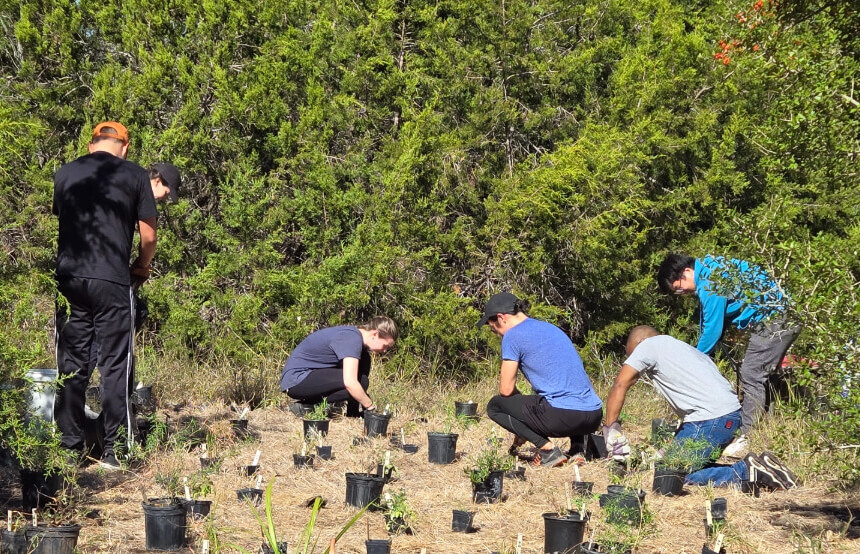
A Rocha USA volunteers planting native species in Austin, Texas.
The series’s first guest is Dr. Katharine Hayhoe, a devout evangelical Christian who also serves as the Chief Scientist of the Nature Conservancy. When she discusses the “root issue” that causes Christians to deny the reality of climate change, she claims that it has “nothing to do with education” and “nothing to do with intelligence.” Rather, the issue is that Christians “have been told that you can’t be a Christian, you can’t be a Republican, or you can’t just be a normal person” if you support things like clean energy and carbon emissions reduction.
So, the primary obstacle between many American Christians and climate action isn’t that they don’t believe climate change exists. They just believe climate action isn’t something that Christians do. (Or evangelicals, Republicans, etc.) To engage with climate action would – at best – force them to live in a way they have no model for. At worst, it would feel like a betrayal of a core tenet of their identity.
The Biblical Roots of Climate Action
This is one of the reasons this podcast series is so vital. Through interviews with believers like Dr. Hayhoe, theologian Dr. Jonathan Moo, activist Brian Webb, and faith leader Taualo Penivao, these episodes seek to help Christians envision how they can fight climate change as an expression of their faith.
Each guest in the series affirms the biblical basis for environmental action, but Jonathan Moo may be the most thorough in doing so. He starts by sharing a passage from Romans 8, which expresses how God’s salvific intent encompasses not only human beings, but all of creation.
In this passage, Paul writes, “For the creation waits with eager longing for the revealing of the children of God. For the creation was subjected to futility [or “decay”]… in hope that the creation itself will be set free from its bondage to corruption and obtain the freedom of the glory of the children of God” (Rom. 8:19-21). The chapter goes on to explain that creation, humanity, and the Spirit groan together as Paul and his readers await “the redemption of [their] bodies” (Rom. 8:22-26).

The Fate of the Animals, by Franz Marc. Public Domain. As an inscription for this piece, Marc wrote, “And All Being is Flaming Suffering.”
Through Romans 8, we see that both humanity and creation suffer, and that both will be liberated from their suffering. As Jonathan explains, the central hope of this excerpt is “our adoption as the children of God, the redemption of our bodies, and for creation: its liberation, its freedom from ruin, because it comes to share in the glory of the children of God.” In this way, Paul affirms that when humanity is saved, salvation will rush out to encompass the rest of creation, too.
Earlier in the same podcast episode, A Rocha USA Executive Director Ben Lowe offers Colossians 1:15-20 as a similar expression of God’s intent to save all of creation. In this passage, Paul describes Jesus as not only the creator and sustainer of all things, but also as the one who “reconcile[s] to himself all things, whether on earth or in heaven, making peace by the blood of his cross” (Col. 1:20).
Taking these passages from Romans and Colossians together, we find that Jesus desires to liberate all of creation from its sufferings and to reconcile it to God. So, if climate change is causing plants, animals, and ecosystems across the globe to suffer, then climate mitigation is a way we can join Christ in the holy work of setting creation free.
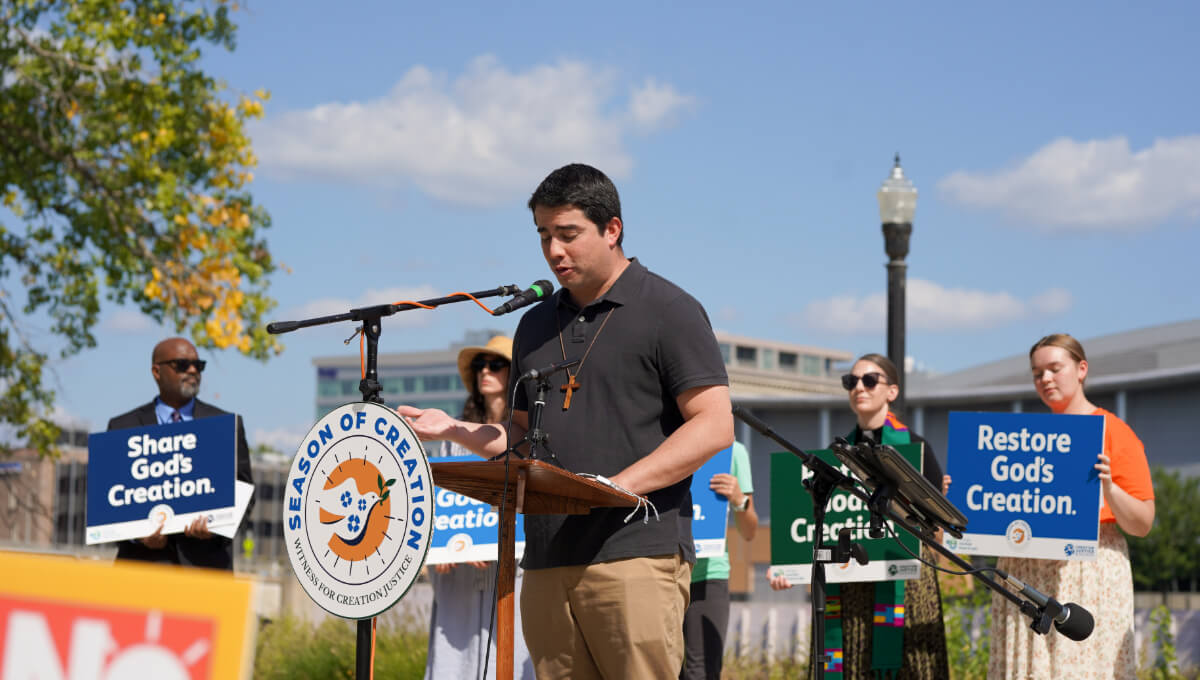
A Rocha USA Executive Director Ben Lowe at a “Witness for Creation Justice” event with Creation Justice Ministries. Photo by Kailey Bailey.
Love the Planet, Love Your Neighbor
Among the many creatures that suffer from climate change are human beings. Taualo Penivao, General Secretary of the Christian Church of Tuvalu, explains how the highest point of his nation is just “two meters above sea level.” As climate change causes oceans to rise, Tuvalu’s coastal lands are drowning, their crops are drenched in saltwater, and their corals are bleaching, killing the sea life and other marine resources the nation relies on.
There are countless other examples of climate change’s impact on human beings. Those of us in the U.S. may think of the climate-driven wildfires in California. More broadly, we may consider the climate-exacerbated droughts, heat waves, and hurricanes that afflict communities across the world. Brian Webb mentions Typhoon Haiyan, which “completely obliterated” the village of Filipino activist Marinel Sumook. In light of such global strife, mitigating climate change becomes crucial to the Christian call to love our neighbor.

Aerial view of Tuvalu’s capital, Funafuti. By Lily-Anne Homasi, on Wikimedia Commons (CC BY-NC-ND 2.0).
So, let’s say I’m convinced: fighting climate change is a way to love my neighbor and to join Christ in liberating creation from its sufferings. What can I do about it, though? How could I – one tiny, feeble human – ever hope to make a dent in such a drastic and global crisis?
This is why Ben Lowe reminds the podcast’s listeners, “[W]e don’t have to do this on our own.” We’re always stronger together, and there are already lots of groups dedicated to mitigating climate change. You can join forces with Christian advocacy groups like Creation Justice Ministries or the Evangelical Environmental Network, or you can volunteer with other political advocacy groups, like the nonpartisan Citizens’ Climate Lobby.
Many of these organizations will encourage you to contact political representatives. Do politicians really pay attention to these kinds of actions, though? Brian Webb insists that they do: when an office in D.C. gets “fifteen calls on a topic,” he claims, “that gets noted to the member of Congress.” Once, during a visit to a Republican’s office in D.C., Brian was delighted to learn that the weekly calls he and about fifteen college students had made to his representative had played a crucial role in convincing him to join the Bipartisan Climate Solutions Caucus.
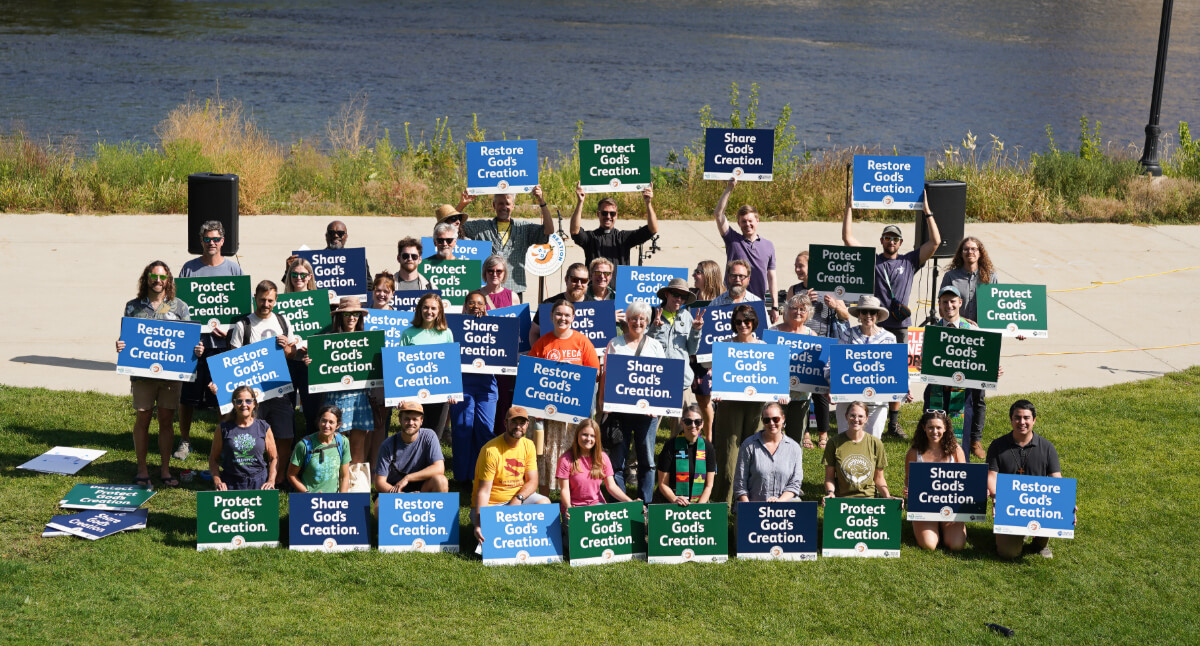
One of Creation Justice Ministries’ “Witness for Creation Justice” events. Photo by Kailey Bailey.
There are other groups you can work with to mitigate climate change, too. Webb recommends advocating through your business, company, or city or state government. You can also encourage your faith community to join one of A Rocha USA’s church programs. Multiple congregations have already worked with us to do an energy audit on their building, so that they can make a strategy for shrinking their carbon footprint.
Living into the New Self
Even with these suggestions and success stories, Christians might struggle to find hope in their environmental efforts. This past year, our politicians in the U.S. have rolled back so many legal protections for God’s creation, we may wonder if there’s any point in trying.
Jonathan Moo responds to this kind of despair by reminding his listeners, “God is making all things new through the Spirit” (Rev. 21:5). He insists that even when our progress in creation care is erased, the “hope of the new creation suggests that… God is able to carry all of that [good work] up into the life of the new creation.” So, no good effort is wasted. Our labors for creation are “not in vain” (1 Cor. 15:58).
There are other ways to motivate ourselves in our climate action, too. Ben Lowe suggests, “Perhaps a more important question for us is not whether we have hope, but what do we love?” If we spend time with God, and if we spend time in nature, then we’ll cultivate love for both. True love always acts on behalf of the beloved, so if we take time to nurture our love for God and creation, we’ll naturally find inspiration to protect it, regardless of whether we have hope that we’ll attain a particular result.

Photo by Treve Johnson Photography.
We encourage anyone who’s seeking renewed inspiration in faith-based climate action to listen through some of this podcast series. If you have loved ones who are skeptical about climate change or about Christian climate action, you might suggest one of these episodes as something to share and discuss.
Whatever our relationship to climate change might be, we can all aspire to put off the “old self” with its abuses against creation, and to put on the “new self” (Eph. 4:20-24) of the Christ who is reconciling all things. At the core of our Christian identity is the calling to be life-givers. So we must, regardless of our political affinity, seek the flourishing of people and habitats across God’s good earth.
What this new self looks like for each of us will be as diverse as the creatures of sky, earth, and sea. But it will always start in the same place: the reconciling love of Christ.
Add a Comment