
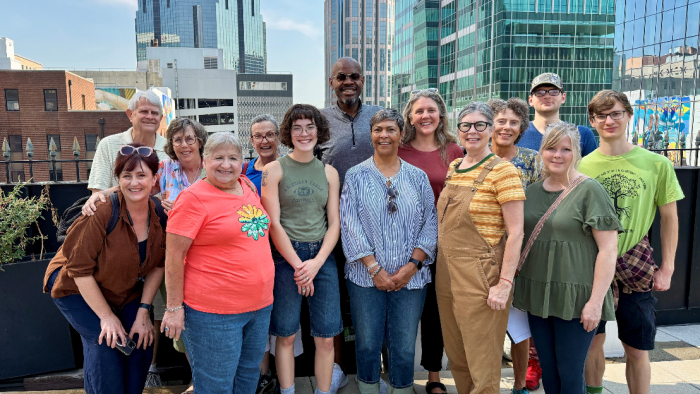
Cover image portrays the 2025/26 Nashville Churches of Restoration Cohort at McKendree United Methodist. Jeremy Simpson, McKendree’s Minister of Worship and Community, is standing in the center in a grey shirt.
by Noah Guthrie
Our Churches of Restoration program helps participating churches integrate care for God’s creation into their congregational lives. These past two years, we have worked with over 50 churches from a diverse range of denominations, regions, and cultural backgrounds. Each church brings its own unique story and circumstances, and each pursues carefully chosen actions, large or small, to take a step forward to care for God’s creatures and landscapes.
This is the story of one participating congregation in Nashville, Tennessee, McKendree United Methodist. We are deeply grateful to Dorothy Davis, Joanne Futrell, and Alf Futrell for their efforts to nurture their church’s creation care practices, and we thank Jeremy Simpson for his fervent advocacy for creation and his willingness to share his thoughts with us.
Oasis and Sanctuary
The desert unfurls like a funeral shroud. Pale as bone, sandy mounds swell and sink, the sun’s glare falling like a bronze cudgel. Spindly cacti shudder, and weeds contort, while a snake writhes its way beneath a stone. All is stewed in heat and dust.
But in one corner of this desert, a cloud of emerald wings up: palms, shrubs, and fronds, vines studded with mauve and crimson flowers. At the grove’s center is a blue pond, its edges embroidered with cattails and bullrushes. The air is fresh – dulcet with the aroma of unfurling blooms, vibrant with the hum of bees.
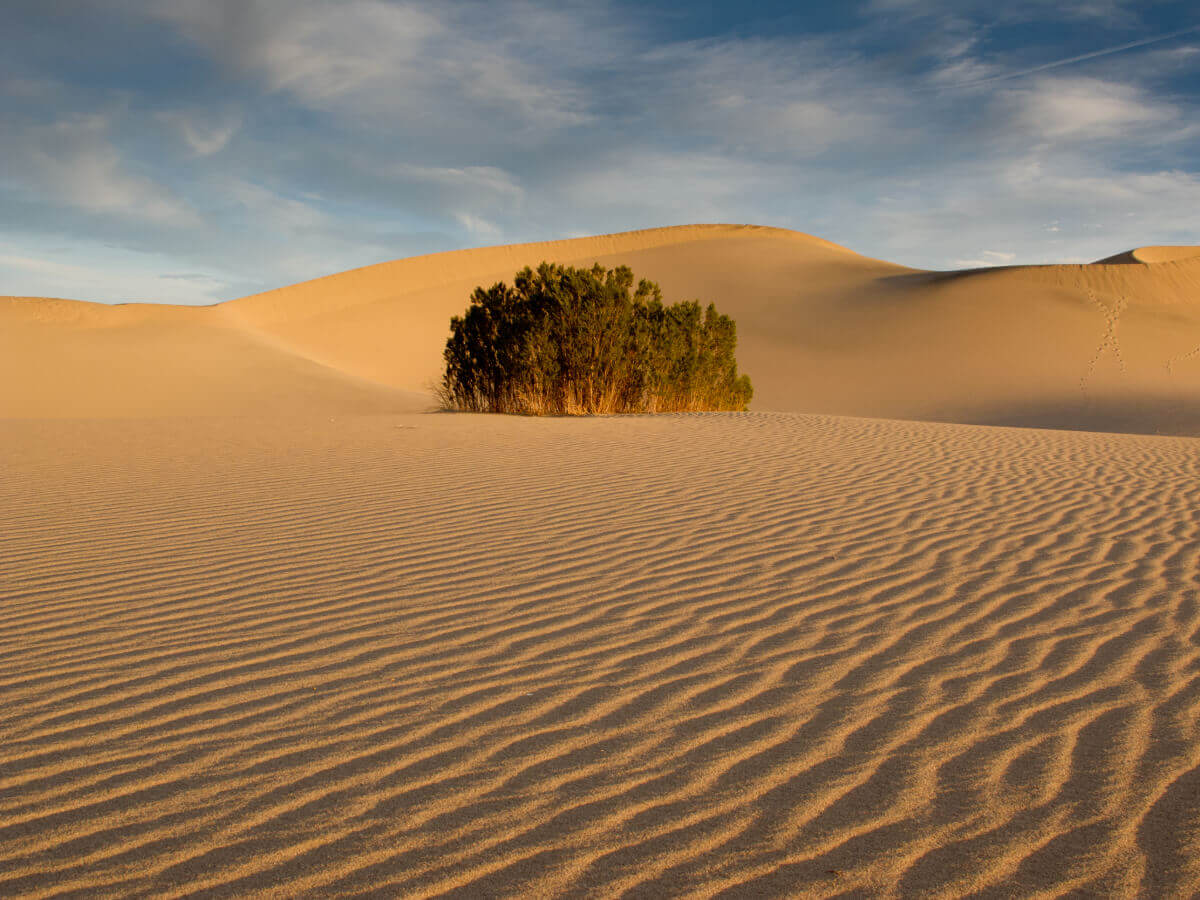
Image by Treve Johnson Photography.
This oasis is one example of a refugium. This ecological term refers to a small pocket of life where plants and animals can shelter in the midst of harsh or disastrous conditions. Other examples may include a crag shielding some shrubs during a volcanic eruption, a shaded stream in the midst of a heat wave, or a wetland protecting amphibians in an urban area. Even when a refugium is small, the remnants of a desolated ecosystem can shelter there, then reemerge once the danger has passed, enabling the whole habitat to rebound.
What if a refugium could also be a building? Jeremy Simpson, the Minister of Worship and Community at McKendree United Methodist Church, heartily affirms this idea. During a recent interview, Jeremy stated that “during times of extreme environmental crisis,” it’s vital for Christian communities to consider how to become a “local refuge… for the sake of the world.” This vision of the Church as a refuge is one of the reasons this congregation joined A Rocha USA’s Churches of Restoration program.
An Urban Refuge
Even before joining this program, McKendree had long been an oasis for the city of Nashville. Only slightly younger than the United States itself, the church began in 1787, then erected a building at their present location in 1833. In subsequent years, they had to rebuild it three times – once due to damage sustained in the Civil War, and twice due to fires. If you visit McKendree’s sanctuary today, you’ll see stained glass windows that were fashioned in 1910.
Based in the thick of Nashville, this congregation is surrounded by many dire needs. “A lot of churches,” Jeremy explained, “being right in the middle of downtown, end up leaving those spaces… But we have really committed to staying in that space and doing what we can to be a neighbor to downtown Nashville and beyond.”
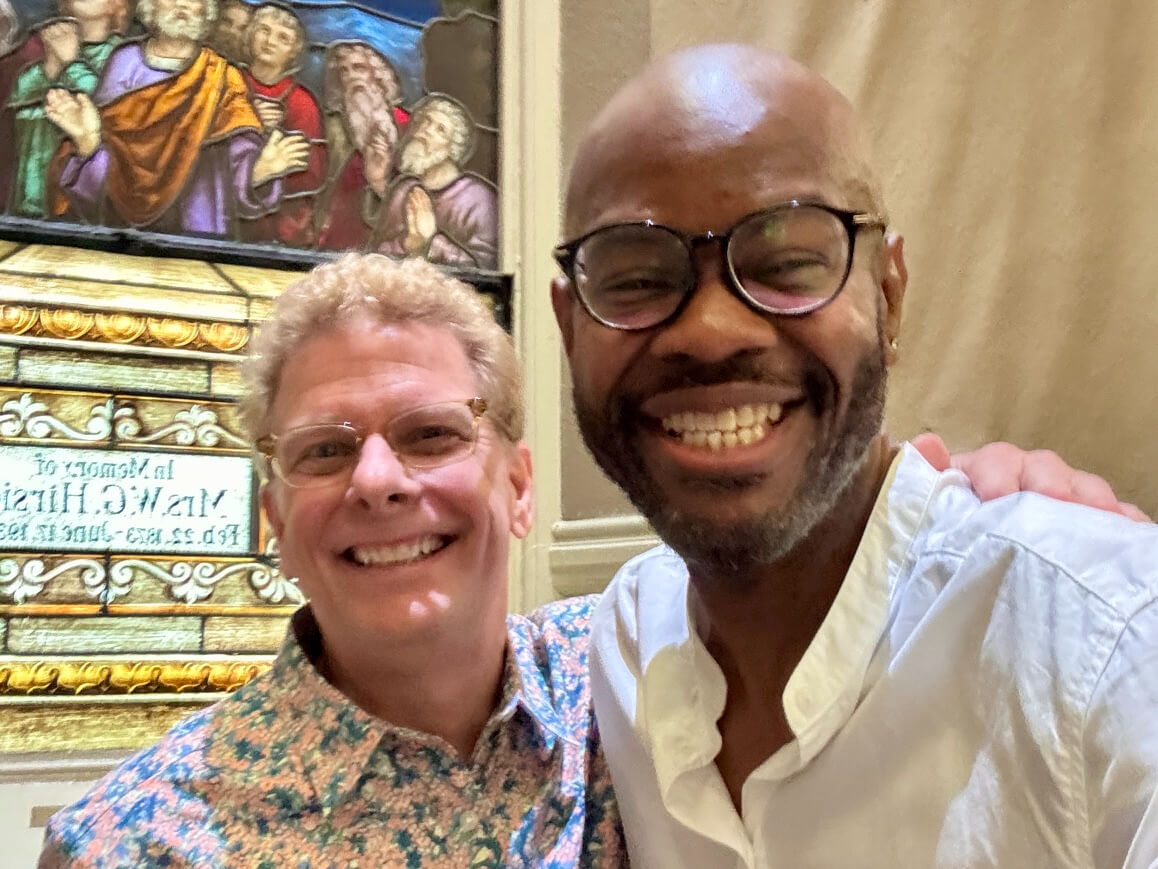
Jeremy Simpson (R) with Ron Rienstra (L), A Rocha USA’s Director of Church Partnerships.
The arid grey dunes of the city sprawl out on all sides, but in the center, there lies an oasis, a sanctuary pouring out life to the surrounding sands. If you visit McKendree, you may encounter those experiencing homelessness, addiction, or hunger, as well as spiritual seekers and the broken-hearted. Anyone can find refuge in this place.
McKendree’s role as a refuge doesn’t limit itself to human beings, though. Jeremy’s concept of “refuge,” in fact, comes from his church’s recent study of Debra Rienstra’s Refugia Faith, a book that envisions how Christians can bless all of God’s creatures and landscapes.
“We can’t be the answer to the entire world’s issues around ecological care,” Jeremy said, “but we can definitely make an impact where we are.” This is part of the beauty of the refugia metaphor: you can make a big difference by caring well for your small corner of the world. Even when just a tiny piece of a habitat is preserved, it can leap out from its shelter and revive a whole ecosystem.
“We can’t be the answer to the entire world’s issues around ecological care, but we can definitely make an impact where we are.”
Jeremy Simpson, Minister at McKendree United Methodist
The Tree of Life
There are multiple ways that McKendree has offered refuge to God’s creation. One way is by planting some trees in front of their building. Another ongoing project is their church recycling program, which has installed collection bins around their building and parking garage. Church volunteers carry the recycling to nearby drop-off sites.
On McKendree’s rooftop, you’ll discover a verdant mural on the wall: a massive tree of life. Its canopy is green, its trunk several barrels thick, and its leafy wings spread over all who pace the tiles below. Beneath this tree, McKendree once cultivated a rooftop garden, and they hope to revive that garden in the coming year. Before long, this space should be a little Eden once more!
McKendree’s rooftop mural.
Jeremy observed that growing a garden in such an urban setting is a way to redeem the space. The garden takes an area that’s “often looked at as a wasteland” – a concrete desert – then shapes it into something beautiful. Hemmed in by asphalt, by the miasma of urban heat, even a little bit of verdure brings hope and refreshment.
You may also notice that McKendree’s tree of life mural stretches its branches out. Rather than cultivating a “bunker mentality,” in which the church barricades its residents against a broken world, McKendree strives to reach out and heal their surrounding community. They aspire to make themselves “an example of renewal and flourishing within downtown Nashville and beyond.”
Refugia Community
One aspect of becoming a refugium for creation is external: we can recycle, garden, reduce energy use, and advocate for creation-conscious laws, for instance. But another vital aspect of becoming a refugium is internal. We must allow the Spirit to reshape our minds and hearts, learning to see creation the way God does.
Referencing Genesis 1, Jeremy explained, “God declared that creation is good. He said that multiple times before humans were even created.” This shows that “nature has value to God, and simply because God made it,” regardless of whether it benefits humanity.
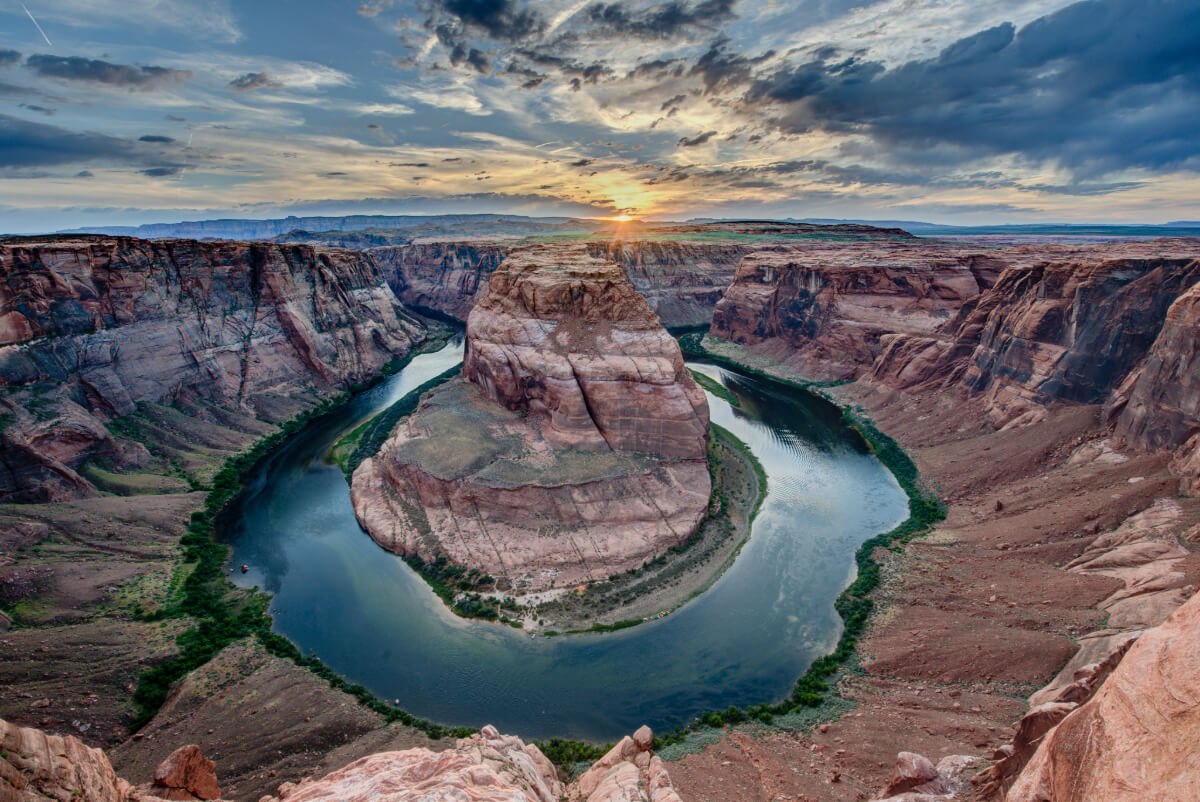
Image by Treve Johnson photography.
Jeremy believes the Bible should reshape our understanding of humanity’s power over creation. He insists that when we read its description of the “dominion” granted to humans over God’s creatures (Gen. 1:26-28), we must reject the “American mentality of domination and control.” Instead, we should take the self-sacrificial rulership of Christ as our example, seeking to nurture creation rather than exploit it. “So,” Jeremy asks, “how can we care for God’s creation, while reflecting God’s love and care for his world?”
One possible answer to this question of “how” is “together.” When people of faith unite over creation care, the Spirit multiplies the fruit of our efforts. This is one of the core principles of A Rocha USA’s Churches of Restoration program, of which McKendree is a part.
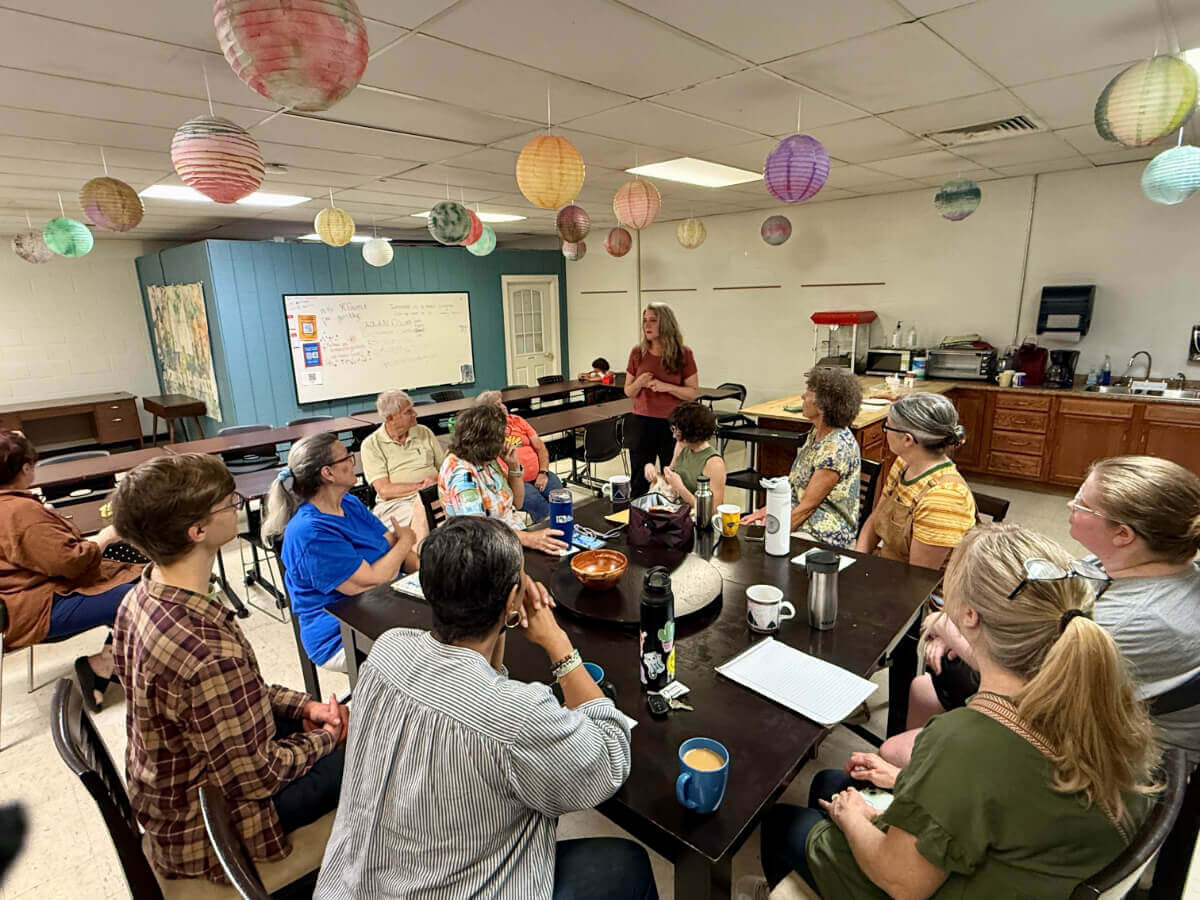
A Churches of Restoration meeting at McKendree United Methodist.
Reflecting on the program, Jeremy stated that churchgoers tend to spend a “lot of time within our silos,” but when we gather into a church cohort, “we’re doing this work together.” He emphasized the importance of believers crossing cultural boundaries to exchange their unique strengths and insights, supporting each other as they protect and restore God’s world.
If there’s power in one refugium – in one congregation offering shelter to God’s creatures – imagine the power of a whole network of refugia. All across the desert, oases open up with green arms outstretched. Creatures from across the dunes come to slake their thirst. The Spirit of God meets them on the face of the waters.
Add a Comment