
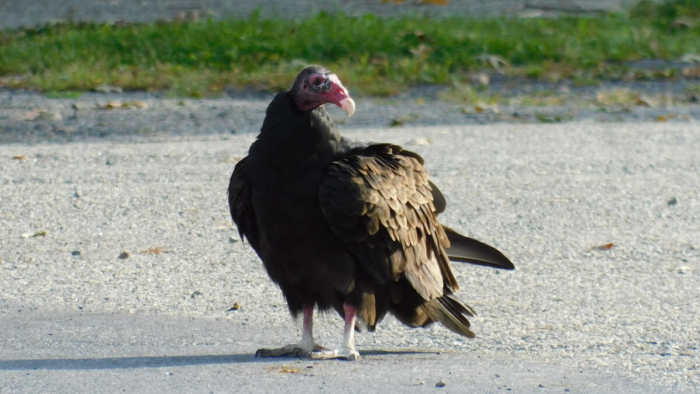
Cover image portrays a Turkey Vulture (Cathartes aura), by Kailyn Liu.
By Kailyn Liu, a 2025/26 Au Sable Education Intern.
Easter of the Vultures
This year’s Holy Week was off to a less-than-beautiful start for me when I noticed a dead squirrel in front of my neighbor’s house. Immediately, I dreaded seeing it decay and attract flies, and considered moving it so it wouldn’t disturb my neighbors or anyone walking by. But I had no idea where to put it, and I feared catching disease from handling the carcass, so I felt stuck.
That evening, an unusual sight occurred — the local flock of Turkey Vultures had gathered right across the street from me. Although I see them flying and roosting all the time, they rarely settle in this area. I didn’t know what they were there for, and I wondered if perhaps a garbage can lid had been left loose.
It was only when I checked my neighbor’s yard the next morning that I made the connection between these events. Nothing was left of the squirrel except a tuft of fur; a vulture had carried it off and eaten it, as I’ve seen them do with the remains of other small animals.
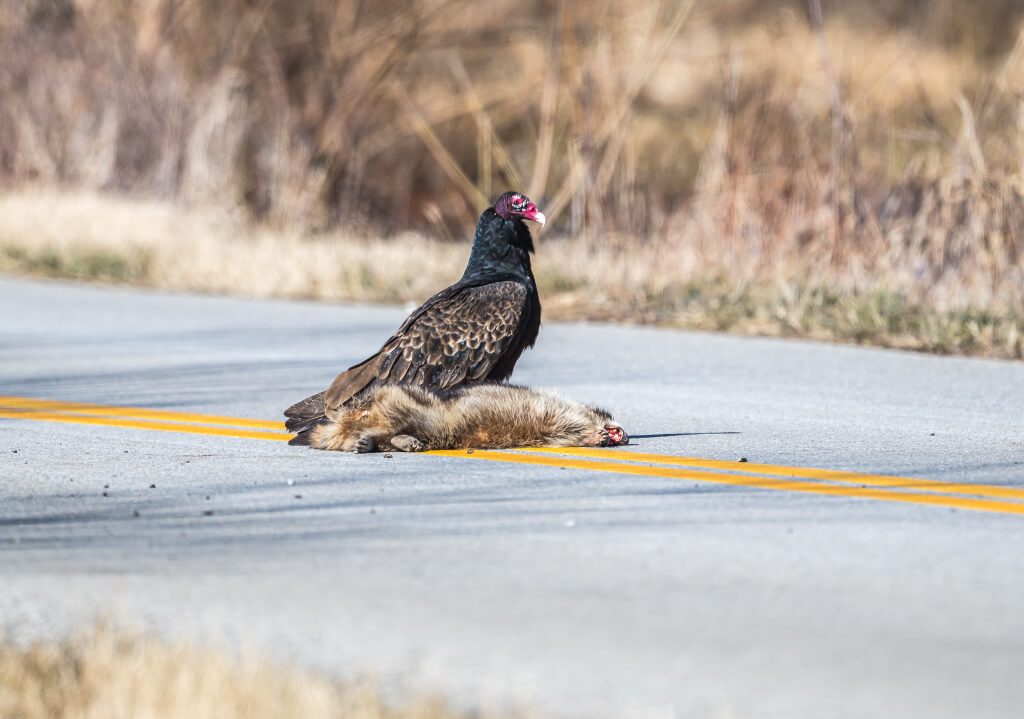
Turkey Vulture (Cathartes aura), by Don Sniegowski, on Flickr (CC BY-NC-SA 2.0).
I’ve heard vultures called “nature’s clean-up crew” before, but it’s so impactful to see them in action in a way that benefits me, the neighborhood, and the ecosystem. This increased my appreciation for vultures, and on a deeper level, the timing during Holy Week encouraged me to think more about the place scavengers and other death-eating species have in God’s creation.
The Curse of Death?
Many religions and philosophies treat death as an essential and permanent part of nature — a framework in which decomposers fit neatly — but many Christians are hesitant to see death as God’s original intent for our world. Some see death as one of the creation-wide consequences of Adam’s sin in Genesis 3. Others cite Romans 8:20-21, which states that creation “was subjected to futility” and will one day “be set free from its bondage to decay,” as evidence that God will ultimately break death’s curse on creation. But if death is unnatural, an “enemy to be destroyed” (1 Cor. 15:26), then why would God create so many creatures that live off it? Why would “the author of life” (Acts 3:15) have such dealings with death?
While there is no obvious answer to these questions, I think that death-eating species ultimately speak to God’s kindness and redeeming nature. Through an intricate network of scavengers, detritivores, and decomposers, God transforms death into a means to sustain life. Plants, which are the foundation of food chains in almost all of Earth’s ecosystems, are themselves supported by nutrients from dead organisms that scavengers have taken apart and that smaller decomposers have broken down into the soil.
God’s words, “You are dust, and to dust you shall return” — a process carried out by decomposers — are a curse. But they also allow a broken world to keep producing life (Gen. 3:19). Even if God has not yet fully restored his creation to what he meant it to be, he still cares for it and makes ways for it to flourish, and decomposition is one of those ways.
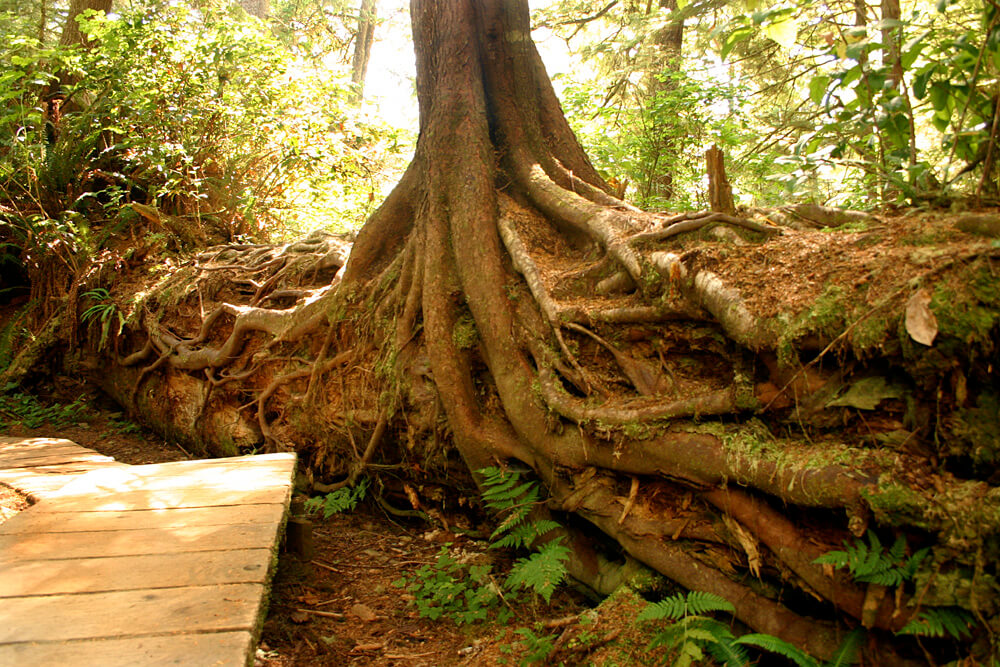
Life rising from a fallen “nurse log.” By Larissa Sayer, on Flickr (CC BY-NC 2.0).
Redemptive Decay
Creatures specialized to handle death ensure that carcasses and dead plants neither accumulate to the point of making the world unlivable, nor ecologically disappear and remove their nutrients from the ecosystem. With decomposers, death does not end in futility for God’s creation.
In addition to recycling nutrients, detritivores and decomposers carry out plenty of ecological services that sustain life. By eating fresh carcasses, detritivores like vultures prevent the spread of disease and reduce the carbon emissions formed by decay (as well as its terrible smells, which I was especially worried about!). Smaller decomposers can then break down the rest of the remains with fewer complications. In this way, different stages of death-eating species work together to maintain the health of an ecosystem.
Another way decomposition fosters new life is through “nurse logs.” These dead tree stumps or logs host tree seedlings alongside a wide variety of life, including mosses, fungi, invertebrates, and amphibians. They are not only a key feature of healthy forests, but also a direct result of decomposition; as bacteria and fungi break down dead trees, they form hollows that shelter other organisms. The decaying wood’s structure allows soil — produced from decomposition of the log and the organisms living in it — to accumulate enough for seedlings to grow. These patterns of decay make space for new kinds of life to find a home in the tree, allowing it to keep contributing to the health of the forest long after it is dead.
I’ve discussed decomposers as sustaining other life by recycling nutrients and shaping habitats, but they themselves are also life, with an incomprehensible diversity of forms and species. When I was an intern at the Au Sable Institute last fall, I was amazed by the variety of fungi and slime molds that lived there along with me. Many of them were saprobic species — creatures that grow and feed on decaying plant matter — so their abundance was thanks to the many fallen logs in the wooded campus. Most fungi that people cultivate, such as Oyster and Shiitake Mushrooms, are saprobic as well, so we directly benefit from their ability to feed on death.
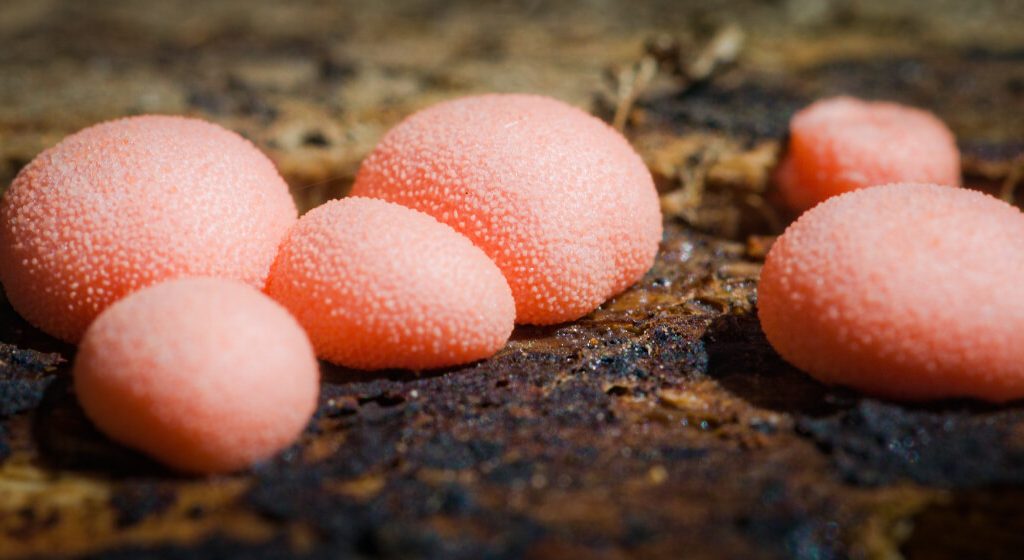
Wolf’s Milk Slime Mold (L. epidendrum), by Hedera Baltica, on Flickr (CC BY-SA 2.0).
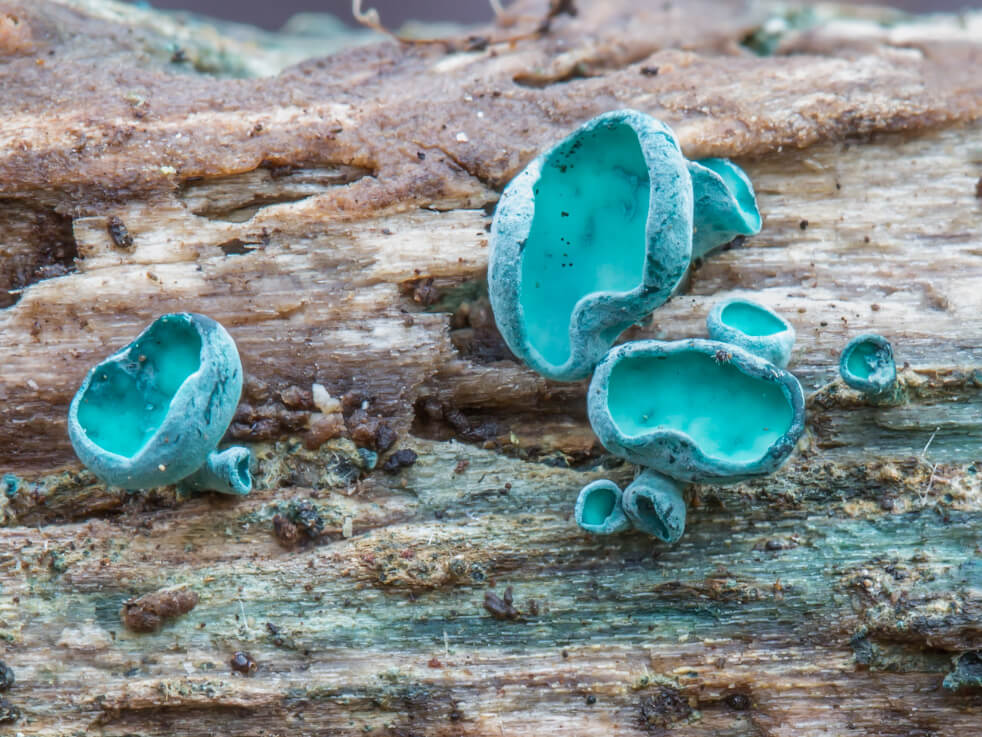
Green Woodcup (C. aeruginascens), by Derek Parker, on Flicker (CC BY-NC-ND 2.0).
Fungi and slimes come in all sorts of forms and colors, like multi-layered brackets of Turkey-tail, massive Resinous Polypores, tiny but striking Green Woodcups, and bubblegum-pink spheres of Wolf’s Milk slime molds. All of these are the “fruiting bodies” of otherwise inconspicuous organisms, only formed when they are ready to spread spores. The exuberant and ephemeral nature of fruiting mushrooms reminds me of parade floats, as if the forest were responding to death with a vibrant party of even more living things.
The media I grew up with often portrayed death-eating creatures as ugly or evil. Cartoons exaggerated vultures’ features to make them more grotesque, so I assumed that was just how they were. But once I observed vultures myself, I saw they had just as much beauty and dignity as any other creature. Seeing their expressive faces, the way they soar with wings raised as if going “woohoo!”, and their subtly iridescent feathers endeared them to me. I understand that liking an organism is not necessary to appreciate its ecological role, and that not everyone will find the same creatures cute or beautiful, but I would still encourage people to not think any less of an organism just because it is a scavenger or decomposer.
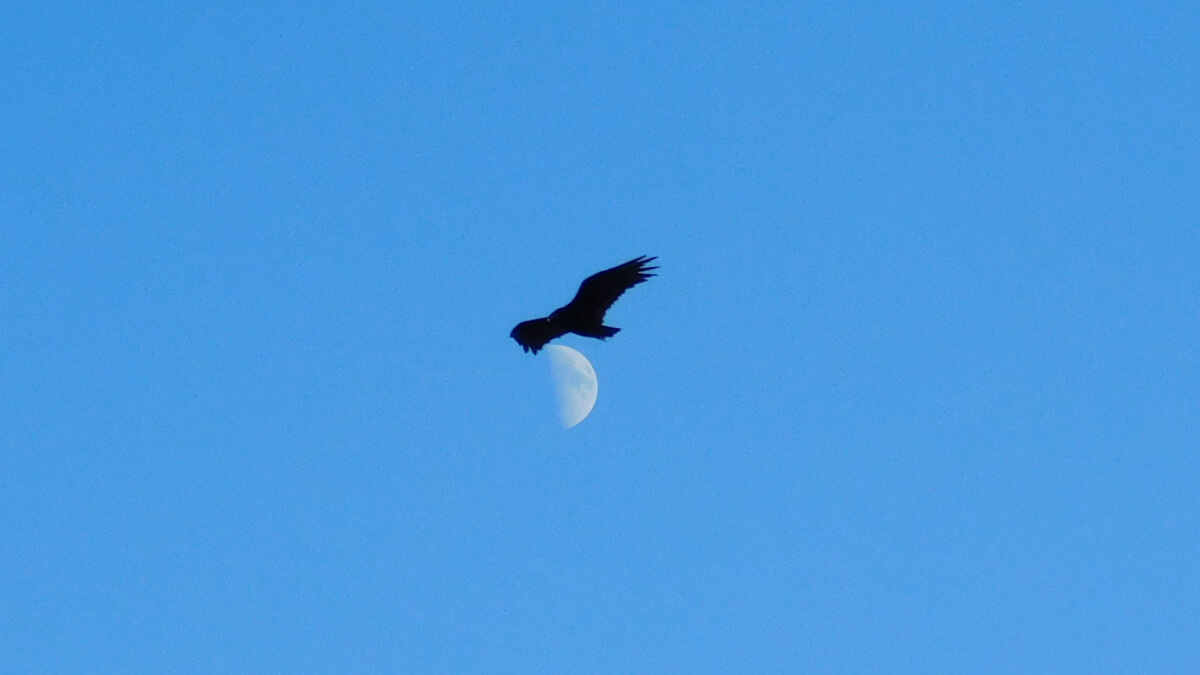
Vulture Over the Moon, “Woohoo!” By Kailyn Liu.
Decomposition seems at complete odds with resurrection, but observing vultures during Holy Week helped me to see how it points to Jesus’ ultimate defeat of death’s power. By dying and coming back to life, Jesus turned death against itself, making a way for us to have eternal life. Decomposers, on a smaller scale, also turn death against itself, making a way to sustain a new generation of life from the remnants of dead organisms.
Decomposition is not the same as resurrection in that a decomposed organism loses its unique identity. But it still displays God’s will to make a way for life to continue even in the presence of death, which is fully expressed in Jesus’ resurrection. Scavengers and decomposers are a reminder that God has been redeeming his creation even in its brokenness, and will do so even more when he fully restores it.
Learn more about our Conservation Internship by watching our video from former intern Mary Bonnell!
Add a Comment